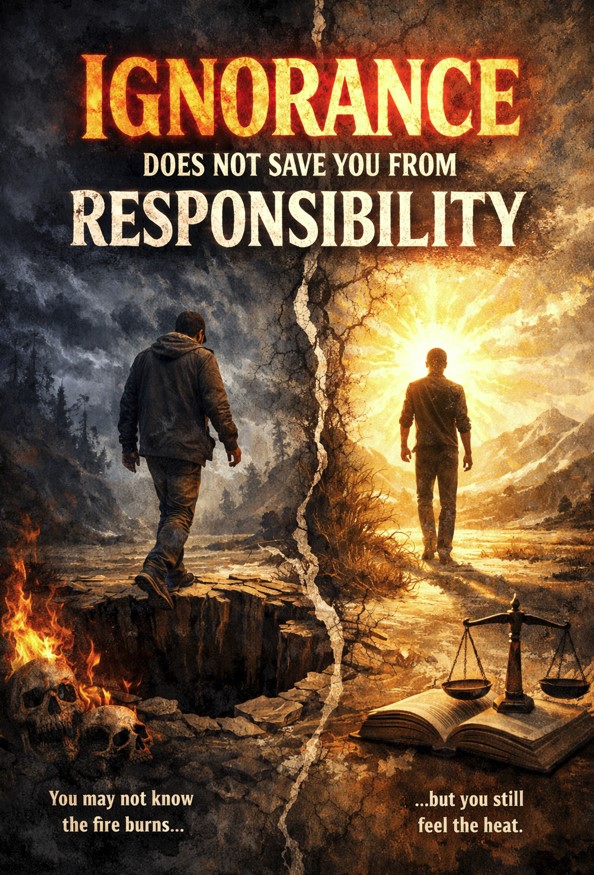
There is a curious superstition in the modern mind—a quiet hope, almost childlike—that ignorance might function as a kind of moral invisibility cloak. If I did not know, we say, then surely I cannot be held accountable. And yet this belief, comforting though it may be, dissolves the moment it is examined.
Ignorance has never been a refuge. It has only been an explanation.
Imagine a man who walks through a field at night and falls into a pit. The pit does not pause to consider whether he knew it was there. Gravity does not convene a committee. Reality is not impressed by innocence. The laws of existence operate with a serene indifference to our awareness of them. You may not know fire burns, but the burn arrives all the same.
And so it is with truth.
The Law That Operates Whether You Believe It or Not
There is a deep confusion—especially in religious and political thinking—between culpability and consequence. One may argue that ignorance lessens guilt, and sometimes it does. But consequence is another matter entirely. You do not escape the harvest because you misunderstood the season.
The universe, if we may speak poetically, is not a courtroom but a mirror. It reflects back what is done, not what was intended. And the reflection is exact.
This is why ancient wisdom traditions—Hebrew, Greek, Eastern alike—spoke not of belief first, but of walking, doing, bearing fruit. Truth was not something you signed off on intellectually. It was something you aligned yourself with, like gravity, like balance, like breath.
The Modern Illusion of Moral Exemption
We live in an age that has elevated ignorance into a virtue. “I didn’t know” has become a mantra, as if lack of attention were the same thing as innocence. But this is a dangerous sleight of hand. For ignorance today is rarely neutral—it is often chosen.
Not chosen consciously, perhaps, but chosen by distraction, by apathy, by outsourcing responsibility to institutions, traditions, leaders, or slogans. And this is the subtle point: you are responsible not only for what you know, but for what you refuse to examine.
To say, “I was raised this way,” or “this is my culture,” or “this is what I was taught,” may explain how you arrived where you are—but it does not absolve you from where you stand now.
Light Reveals; It Does Not Excuse
There is a profound misunderstanding of mercy in religious thinking. Mercy is often imagined as the cancellation of consequence. In truth, mercy is illumination. It shows you the pit before you fall in again.
But illumination itself creates responsibility. Once you see, you cannot unsee. Once you hear, you cannot claim silence. This is why sacred texts so often speak of eyes to see and ears to hear. Awareness is not a comfort—it is a burden.
And yet it is the only burden that leads to freedom.
Why Ignorance Is So Tempting
Ignorance offers something seductive: the illusion of safety without transformation. It allows one to remain unchanged while hoping for different results. It whispers, “Surely someone else will handle this.” But the universe does not delegate responsibility. It individualizes it.
You are not punished for ignorance. You are shaped by it.
The Quiet Invitation
This is not a message of condemnation—it is an invitation to maturity. To step out of the nursery of excuses and into the dignity of awareness. Responsibility is not the enemy of grace; it is the doorway to it.
For the moment you stop saying I didn’t know is the moment you begin to ask, What is true?
And that question—asked honestly—is the beginning of understanding.
Not because it saves you from consequence,
but because it aligns you with reality itself.
And reality, unlike ignorance, does not lie.